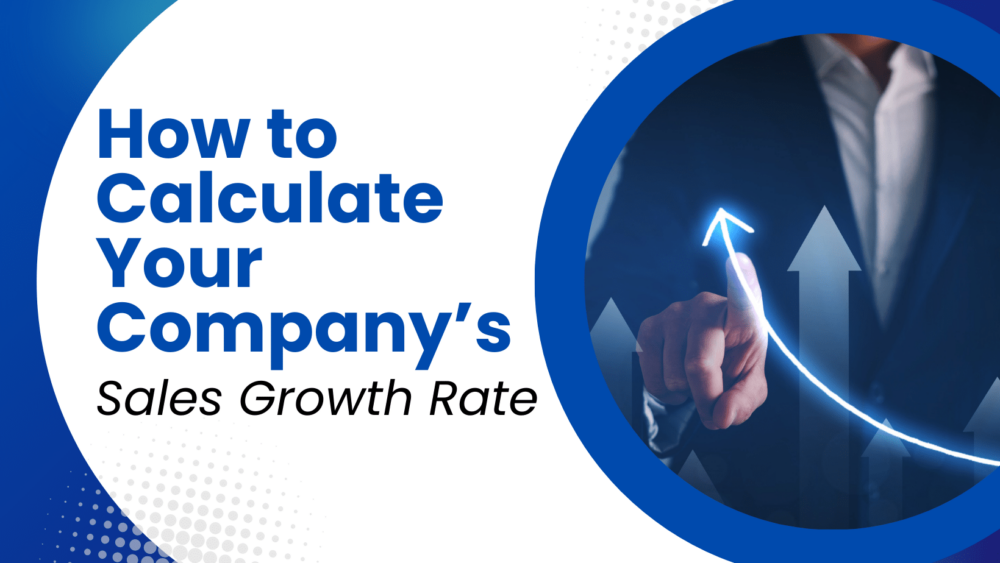
How to Calculate Your Company’s Sales Growth Rate
Learn how to calculate your sales growth rate, track key metrics, and use effective tools to drive business growth and achieve your sales goals.
Tracking sales metrics is important for any successful business. Understanding the sales growth rate helps you see how your sales efforts impact overall business growth. This metric provides valuable insights, allowing you to make informed decisions and adjust strategies to boost your company’s performance. Knowing how to calculate your company’s sales growth rate ensures you stay on track for continued success.
Understanding Sales Growth Rate
The sales growth rate measures how quickly a company increases its revenue over a specific period. It’s a key metric that shows how well your sales strategies are working. Tracking this rate helps in making data-driven decisions.
If the rate drops, it signals the need for a new approach. A rising rate indicates that your business is on the right path, driving business growth and success. Monitoring other sales metrics like average deal size and conversion rate provides a fuller picture of performance.
Sales Growth Rate Formula
To calculate your company’s growth rate, you need the net sales value of the initial period and the net sales value of the current period. These values are typically found on an income statement. Here’s the formula:
Formula: (Current Period Net Sales – Initial Period Net Sales) / Initial Period Net Sales × 100
Step-by-Step Guide
- Find the net sales value for the initial period.
- Find the net sales value for the current period.
- Subtract the initial period value from the current period value.
- Divide the result by the initial period value.
- Multiply by 100 to get the percentage.
Example: Calculating Sales Growth Rate
Let’s take Fake Co. as an example. Fake Co. reported $500,000 in sales for 2021 and $750,000 for 2022.
Using the formula:
($750,000−$500,000)/$500,000×100=50%(\$750,000 – \$500,000) / \$500,000 \times 100 = 50\%($750,000−$500,000)/$500,000×100=50%
This means Fake Co. experienced a growth rate of 50% from 2021 to 2022. This significant increase suggests successful sales strategies and positive business growth. Tracking other metrics like cash flow and monthly recurring revenue (MRR) can also provide deeper insights.
Average Annual Sales Growth Rate
The average annual sales growth rate measures how much a company’s sales have grown over several years. It’s a valuable metric for assessing long-term business growth.
How to Calculate It
To calculate the average annual rate, you first determine the growth rate for each year. Then, you average these rates over the desired period.
Formula: (Growth Rate Year 1 + Growth Rate Year 2 + Growth Rate Year 3 + …) / Number of Years
Example: Calculating Average Annual Sales Growth Rate
Let’s examine Your Company. Here are the sales figures and growth rates for the past four years:
- 2018: $950,000
- 2019: $1,000,000 (Growth Rate: 5.26%)
- 2020: $1,125,000 (Growth Rate: 12.5%)
- 2021: $1,200,000 (Growth Rate: 6.67%)
- 2022: $1,400,000 (Growth Rate: 16.7%)
To find the average annual sales growth rate:
(5.26%+12.5%+6.67%+16.7%)/4=10.28%(5.26\% + 12.5\% + 6.67\% + 16.7\%) / 4 = 10.28\%(5.26%+12.5%+6.67%+16.7%)/4=10.28%
This means Your Company had an average annual growth rate of 10.28% over these four years. This steady growth indicates strong sales strategies and a healthy customer base.
Factors Influencing Sales Growth Rate
Several factors can impact a company’s growth rate. Understanding these can help you set realistic goals and adjust your strategies effectively.
Company Size
Small businesses often see higher growth rates compared to larger companies. This is because smaller revenue changes can significantly affect the growth percentage. For example, a small business increasing sales from $500,000 to $750,000 sees a 50% growth rate, whereas a larger company increasing from $10 million to $12 million sees a 20% growth rate.
Competitive Landscape
Industry performance plays a big role. If your industry is thriving, your company might experience higher growth. Conversely, if the industry faces challenges, individual companies may struggle to grow. For instance, e-commerce businesses saw significant growth in 2022 while retail sales decreased.
Sales Goals
Setting realistic and strategic goals is essential. Your sales team needs clear targets to aim for, which should align with overall business growth objectives. Regularly reviewing and adjusting these goals based on performance and market conditions ensures sustained growth.
What is a Good Sales Growth Rate?
A “good” growth rate varies widely by company and industry. Different businesses have unique benchmarks and expectations based on their size and sector.
Benchmarks and Expectations
- Small Businesses: Smaller companies often aim for higher growth rates because even modest increases can significantly impact their revenue. For small businesses, a sales growth rate of 10-20% might be considered good.
- Large Corporations: Larger companies typically see lower growth rates due to their substantial revenue base. For them, a 5-10% sales growth rate can be impressive.
- Industry Sectors: Different industries have varied benchmarks. For example, tech startups might aim for high growth rates, while mature industries like manufacturing might have lower expectations. Understanding your sector’s typical sales growth rates helps set realistic sales goals.
Overall, a good sales growth rate aligns with your business size, industry standards, and strategic objectives.
Tools for Tracking Sales Growth
Using sales tracking tools helps monitor your company’s performance and make informed decisions. These tools allow you to stay on top of key sales metrics and adjust strategies as needed.
HubSpot’s Sales Metrics & KPI Calculator
HubSpot offers a Sales Metrics & KPI Calculator, which makes it easy to measure important sales metrics. This tool helps you understand how your sales strategies impact your business growth and bottom line.
The Role of Technology
Technology helps track sales data and sales analytics in real-time. With the right tools, you can monitor progress, forecast sales, and make necessary adjustments to achieve your sales goals.
Other Tools that Help Track Sales
- Google Analytics
- Salesforce Sales Cloud
- Pipedrive
- Zoho CRM
- Microsoft Dynamics 365
These tools offer various features to track sales growth, analyze data, and improve your sales strategies. Implementing them can help your sales team achieve better results and drive business growth.
Do Your Due Diligence
Regular tracking and analysis of growth help maintain your business performance. Comparing your sales data with competitors provides valuable insights. Set clear sales targets and use reliable tools to measure progress. This approach allows for informed decisions and necessary adjustments to your strategies.
Staying Ahead with Sales Growth
Understanding and calculating growth helps you track business performance. Using reliable tools and methods ensures accurate tracking and analysis. Stay informed and proactive in your strategies for continuous improvement and success.
To refine your sales forecasting, regularly review metrics like monthly recurring revenue (MRR), churn rate, average deal size, and conversion rate. Engage your sales manager and team in monitoring cash flow and customer retention. By following these practices, businesses can drive growth and achieve their goals.